You walk in, smell something off, and find a wet patch on the wall by the door. Your first thought is probably some version of “why would you do this to me.” It feels personal. It feels like payback for something, maybe that vet visit, maybe the new roommate, maybe nothing you can even identify.
It’s not payback. It’s a message, and once you learn to read it, the wet wall stops being a mystery and starts being information.
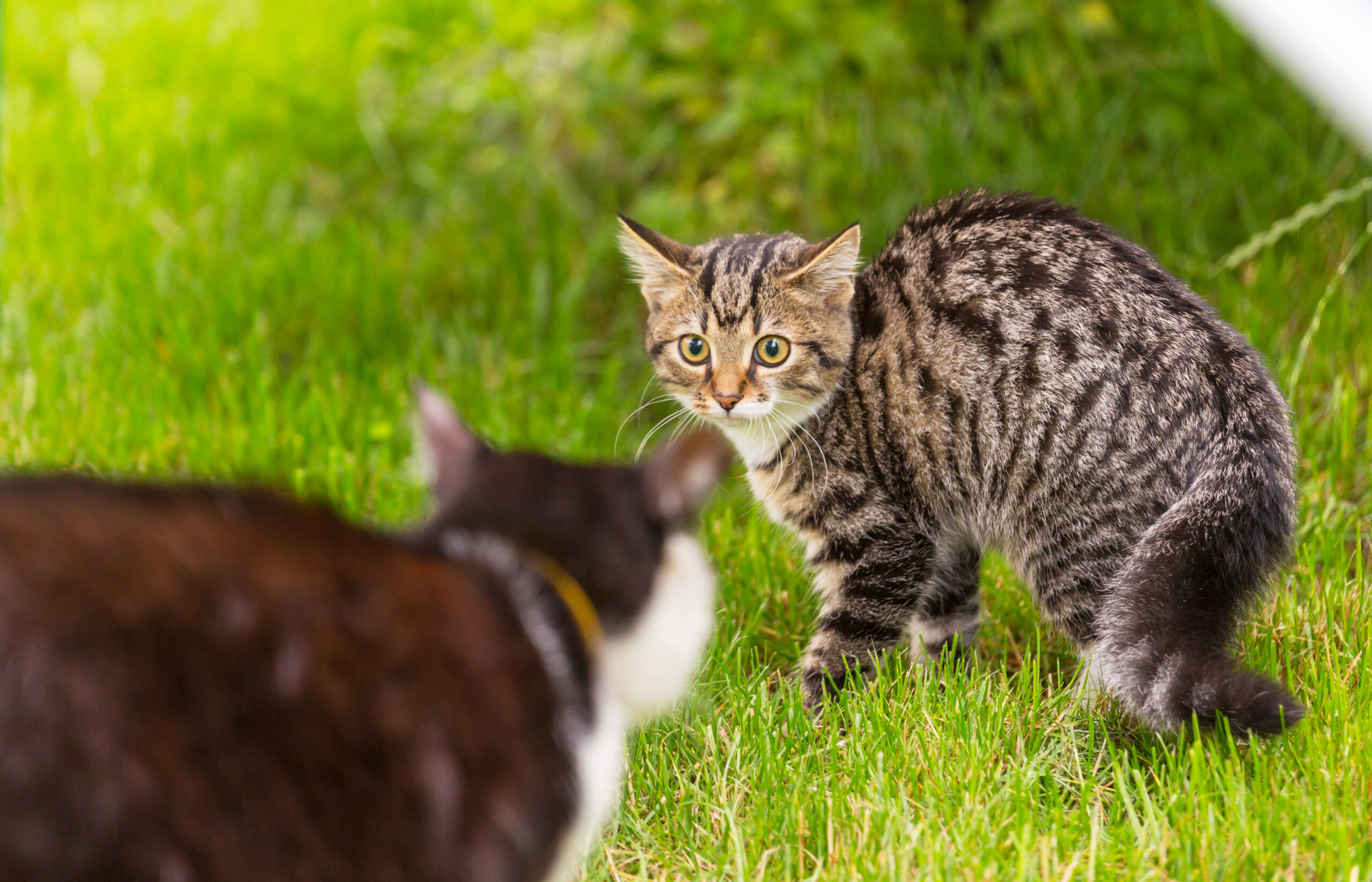
Spraying isn’t misbehavior, defiance, or spite. It’s a normal feline communication behavior that only becomes a “problem” because it happens in human homes instead of out in the wild. Cats evolved to use scent, especially urine, to communicate territory, safety, stress, and social standing. That system works great between cats. It works a lot less great when the message lands on your couch.
Is it always spraying, though? Not necessarily, and the distinction matters. Spraying usually means a small, deliberate amount of urine on a vertical surface (a wall, a door, a window), often while your cat is standing with tail upright and quivering. If your cat is instead leaving larger amounts on the floor or other horizontal surfaces, that’s more likely inappropriate elimination, which can stem from litter box aversion, a medical issue, or a different kind of stress entirely. The two get lumped together constantly, but they’re not the same problem and don’t always call for the same fix.
This distinction matters a lot, because house soiling broadly (spraying and inappropriate elimination both) is one of the leading reasons cats end up surrendered. It accounts for a meaningful share of all shelter cat intakes, and it’s consistently cited as one of the top behavioral reasons owners give up their cats. The frustrating part is that most of these cases are preventable or resolvable once you understand what’s actually driving the behavior, which is exactly why it’s worth ruling out before assuming the worst.
So why do cats spray? A few overlapping reasons:
Hormones: Intact cats, especially males, spray far more than sterilized ones. Spaying and neutering reduce the behavior but don’t erase it entirely. Research suggests roughly 10% of neutered males and 5% of spayed females may still spray under certain conditions, and when that happens, it’s rarely about leftover hormones. It usually points to something else on this list.
Conflict at home: Tension with another cat in the house, competition over resources, or just general crowding can all show up as spraying.
Outside pressure: Unfamiliar cats hanging around outside, visible through a window or door, can read as a territorial threat even though your cat never makes contact with them.
Big changes: Moves, renovations, new pets, new people, or the loss of a companion can all throw off what’s basically your cat’s internal scent map.
Medical stress: Pain or urinary issues can contribute to house-soiling too, which is why a vet visit is always worth ruling out early rather than assuming it’s purely behavioral.
A couple of myths are worth retiring while we’re at it. It’s not revenge. Cats don’t link urine placement to punishment or fairness, so there’s no “getting back at you” happening. Punishment doesn’t help either. It raises stress and insecurity, which are exactly the conditions that drive spraying in the first place, and at best it just pushes the behavior somewhere more hidden. And it’s not purely a male issue. Females spray too, particularly in multi-cat households.
Here’s what actually helps:
Track the pattern before assigning blame. Note where it’s happening, what changed beforehand, and whether other cats (inside or outside) are involved.
Clean marked areas with an enzymatic cleaner, not an ammonia-based product, which can backfire and draw cats back to the same spot. Nature’s Miracle and Rocco & Roxie are both widely recommended and easy to find; Hepper’s enzyme spray is a solid pick if you want something fragrance-free.
Add visual barriers like curtains or window film if outdoor cats are part of the trigger.
In multi-cat homes, make sure there are enough litter boxes and that food, water, and resting spots aren’t forcing cats to compete or cross paths constantly.
Consider calming pheromones (like Feliway) as part of a broader plan rather than a standalone fix.
Use positive reinforcement to redirect your cat toward a mat or bed instead of a known hotspot.
Loop in a vet or veterinary behaviorist for anything that’s persistent, layered, or not responding to the basics. Sometimes a prescription diet or a more targeted behavioral plan is what closes the gap.
The throughline here is the same as always. Figure out the why, and you’ll find a lot more options than “just live with it,” or worse, giving up on your cat altogether.
Sources
American Association of Feline Practitioners & International Society of Feline Medicine. (2014). AAFP–ISFM Feline House-Soiling Guidelines. Journal of Feline Medicine and Surgery. https://journals.sagepub.com/doi/10.1177/1098612X14539092
Horwitz, D. F. (2019). Common Feline Problem Behaviors: Urine Spraying. Veterinary Clinics of North America: Small Animal Practice. https://pubmed.ncbi.nlm.nih.gov/30810092/
Pryor, P. A., et al. (2001). Causes of urine marking in cats and effects of environmental management on frequency of marking. Journal of the American Veterinary Medical Association. https://pubmed.ncbi.nlm.nih.gov/11767919/
Barcelos, A. M., et al. (2018). Common Risk Factors for Urinary House Soiling (Periuria) in Cats and Its Differentiation: The Sensitivity and Specificity of Common Diagnostic Signs. Journal of Feline Medicine and Surgery. https://www.frontiersin.org/journals/veterinary-science/articles/10.3389/fvets.2018.00108/fu
ll
Mills, D. S., et al. (2011). Meta-analysis of the Efficacy of Treatments for Feline Urine Spraying. PLOS ONE. https://journals.plos.org/plosone/article?id=10.1371/journal.pone.0018448
Pageat, P., & Gaultier, E. (2003). Current research in canine and feline pheromones. Veterinary Record. https://www.vetsmall.theclinics.com/article/S0195-5616(02)00128-6/abstract