You’re dead asleep. Then, out of nowhere, full-speed sprint down the hallway, a flying leap onto the bed, a face six inches from yours, purring like a motorcycle. It’s 3am. Again.
If you’ve ever chalked this up to “cats are just nocturnal,” you’re in good company. It’s one of those facts everybody seems to know, which makes the 3am chaos feel less like a problem and more like a personality trait you signed up for when you got a cat. Nocturnal is just what cats are, right? Nothing to be done.
Except that’s not actually true, and once you know why, the whole thing gets a lot less mysterious and a lot more solvable.
Cats aren’t nocturnal. They’re crepuscular.
Crepuscular means most active at dawn and dusk, not all night long. “Nocturnal” implies your cat is just wired to be a nighttime creature, full stop, so there’s nothing you can really do about the 3am parkour. “Crepuscular” tells you there’s an actual trigger tied to specific windows of the day, which means there’s something to work with.
So why dusk and dawn specifically? Blame evolution. Cats have only recently become indoor animals (kitty litter wasn’t even invented until the 1950s), so their internal clocks are still tuned to an outdoor hunting schedule. Dusk and dawn are when small prey animals are most active and least cautious, which makes those windows prime hunting time. Your cat’s biology hasn’t gotten the memo that dinner now comes from a bag.
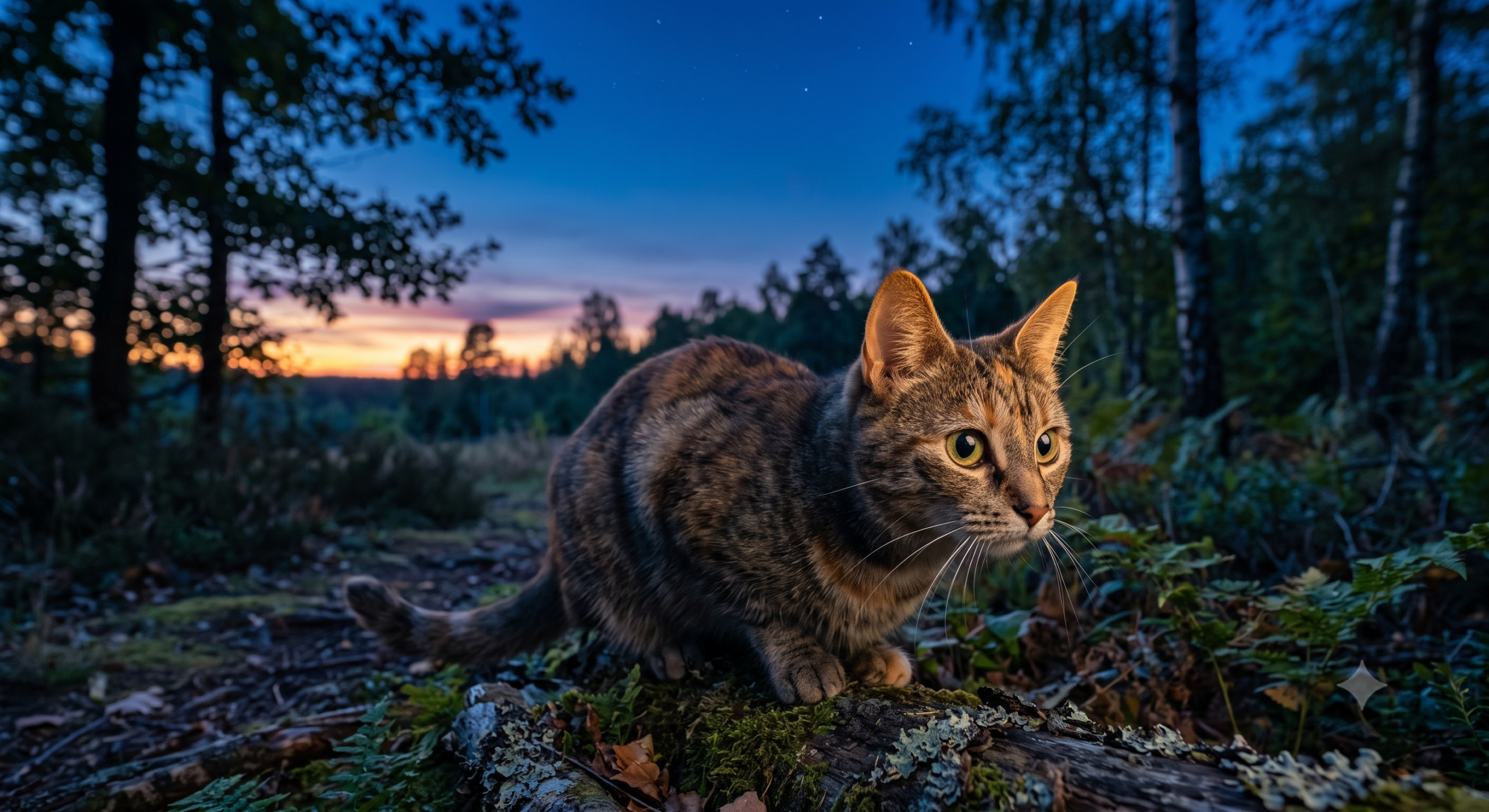
But let’s take a closer look at some of those early-morning and late-night shenanigans:
The 3am zoomies
What it is: pure prey drive with nowhere to go. Your cat is biologically primed to hunt right now and there’s no mouse to chase, so you get the full-speed lap around the apartment instead.
What helps: a structured play session before bed. Get your cat through a full hunt-catch-eat cycle with a wand toy, then feed a small snack right after to round out the “hunt and eat” sequence. This is one of the most consistently effective fixes out there. Cats with regular enrichment have shown nearly half the stress hormone levels of cats without it, so you’re not just burning off energy, you’re lowering the overall tension that makes the zoomies worse.
The furry alarm clock
What it is: pawing your face, sitting on your chest, walking across you like you’re a hallway. Your cat has figured out that you are a reliable source of breakfast, and they would like to redeem that now, please.
What helps: an automatic feeder set for early morning. Take yourself out of the equation and let the machine be the bad guy.
The vocalizer
What it is: yowling or chirping at a window, usually because something outside (a bird, a cat, a particularly bold raccoon) has caught their attention.
What helps: closing blinds or curtains overnight to remove the visual trigger, or white noise to muffle outside sounds. One quick note: if an older cat suddenly starts vocalizing more at night, it’s worth mentioning to your vet, since it can occasionally signal cognitive changes.
The demolition crew
What it is: knocking things off shelves, scratching furniture, general overnight mayhem. Usually curiosity or attention-seeking, and if it’s ever gotten a reaction out of you, your cat has filed that away as “this works.”
What helps: puzzle feeders and enrichment toys that give that curiosity somewhere to go besides your bookshelf.
The door scratcher
What it is: scratching or yowling at a closed door. This is less “I want you specifically” and more “I want access to that space,” especially if your cat is used to having it.
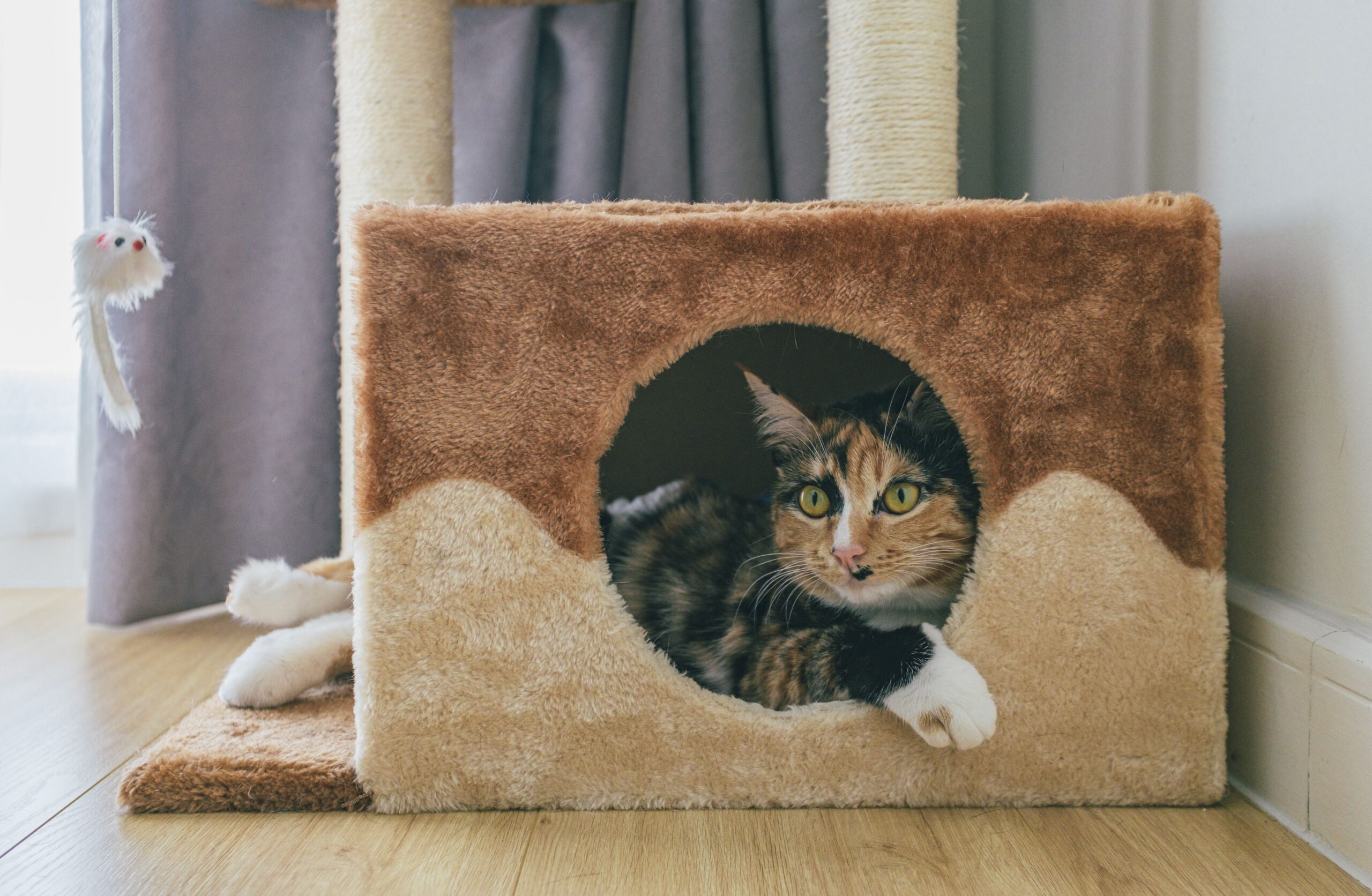
What helps: a cat tree or window perch elsewhere in the house can redirect some of that territorial restlessness. Worth noting, though: if the distress seems tied specifically to being shut out and separated from you, rather than just wanting a room, that can sometimes be a separation-related issue rather than a crepuscular one. Those call for a different approach, so it’s worth thinking through which one you’re actually seeing.
The overnight social club
What it is: in multi-cat households, sometimes the 2am noise isn’t distress at all. It’s play, grooming, wrestling, a whole little party you weren’t invited to.
What helps: honestly, sometimes nothing needs fixing here. If everyone’s getting along, let them have their club.
A few things that help across the board, regardless of which behavior you’re dealing with: a consistent evening routine (feeding schedules and your own activity patterns are some of the strongest cues your cat picks up on), and going in patient rather than frustrated. We’re all a little more short-tempered when we’re sleep deprived, but punishment doesn’t help here. It just adds anxiety on top of a behavior that was never about defiance in the first place.
And speaking of patience, none of this is an overnight fix. A week of consistent play sessions and a closed blind or two isn’t going to undo these ingrained behaviors immediately, but stick with it, and you’ll start seeing your cat’s energy shift toward a more compatible schedule.
Sources
Calder, C. (2023). Separation-related problems in cats. IAABC Foundation Journal.
https://journal.iaabcfoundation.org/separation-related-problems-in-cats/
Chebly, A., et al. (2025). Assessing the circadian rhythm of cats living in a group using accelerometers. Applied Animal Behaviour Science. https://arxiv.org/abs/2410.06594
de Souza Machado, D., et al. (2020). Identification of separation-related problems in domestic cats. PLOS ONE, 15(4), e0230999. https://doi.org/10.1371/journal.pone.0230999
Kogan, L., Kolus, C., & Schoenfeld-Tacher, R. (2017). Assessment of clicker training for shelter cats. Animals, 7(10), 73. https://doi.org/10.3390/ani7100073
Parker, M., et al. (2019). Daily rhythms in food intake and locomotor activity in a colony of domestic cats. Animal Biotelemetry, 7, 22. https://doi.org/10.1186/s40317-019-0188-0
Rehnberg, L.K., et al. (2015). The effects of social interaction and environmental enrichment on stress of owned housecats. Applied Animal Behaviour Science, 169, 51-61. https://doi.org/10.1016/j.applanim.2015.06.002
Schwartz, S. (2002). Separation anxiety syndrome in cats: 136 cases (1991-2000). JAVMA, 220(7), 1028-1033. https://avmajournals.avma.org/view/journals/javma/220/7/javma.2002.220.1028.xml
Willson, E.K., et al. (2017). Comparison of positive reinforcement training in cats: A pilot study. Journal of Veterinary Behavior. https://www.sciencedirect.com/science/article/abs/pii/S1558787817301533
Wojtaś, J., et al. (2024). The impact of environmental enrichment on the cortisol level of shelter cats. Animals, 14(9), 1392. https://doi.org/10.3390/ani14091392
Yaw, A.M., et al. (2025). Light quality and time in shelter modulate behavior and cortisol in the domestic cat. iScience, 28(6), 112709. https://doi.org/10.1016/j.isci.2025.112709