Every October, Good Mews heads into the beautiful city of Atlanta, pitches a tent amongst hundreds of others, and plants rainbow flags across Piedmont Park for all to see. Not as a political statement, but as a point of pride. We join and show up because we know a thing or two about belonging.
At Good Mews, that word means finding the right home for a cat who’s been waiting for one, matching a life to a life, making sure nobody gets left out of having a family. But belonging also means understanding that family can look different for everyone, and that not every family is treated fairly in this world. Those two meanings of belonging, the home you’re placed in and the people who accept you as you are, aren’t as separate as they might seem. They’ve been tangled together in animal welfare history for a long time.
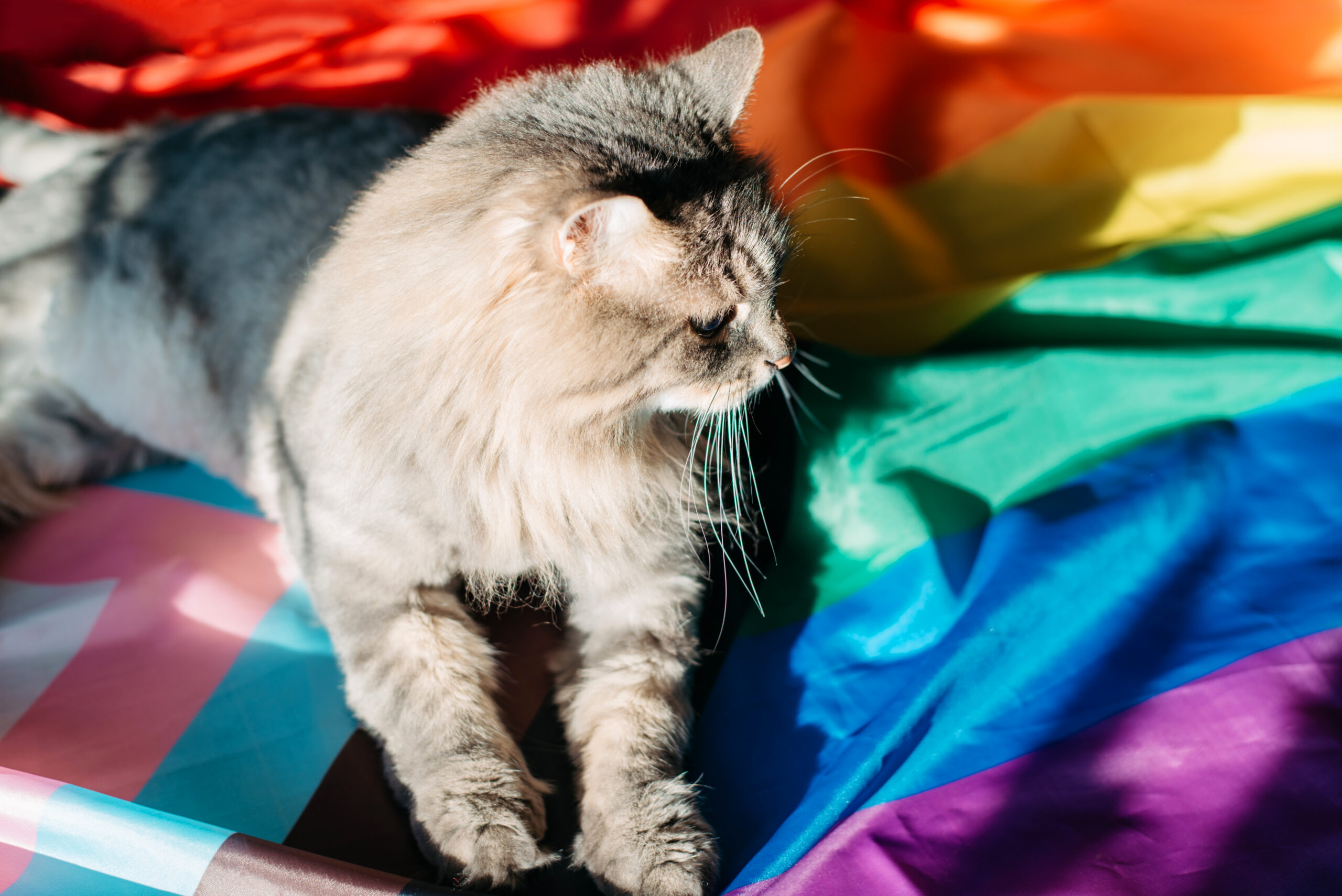
That history runs deeper, and further back, than most people know. Some of the most consequential figures in the story of animal advocacy were queer people who never separated their love for animals from their understanding of who deserves protection.
“The person who built the foundation of the modern animal advocacy movement was queer.”
Frances Power Cobbe was an Irish writer and activist who, in 1875, founded the first organization in history to campaign against animal experimentation, work that helped lead to Britain’s Cruelty to Animals Act the following year. She also shared her life openly with her partner, sculptor Mary Lloyd, referring to her in her own writing as both husband and wife, and she publicly argued against the criminalization of same-sex relationships decades before it was safe to do so. Cobbe didn’t treat her causes as separate. She saw the mistreatment of animals and the mistreatment of vulnerable people as expressions of the same underlying cruelty, and she spent her life fighting both.
That same instinct showed up again decades later, on the other side of the Atlantic. Alice Morgan Wright and her lifelong companion Edith Goode became two of the most consequential figures in American animal welfare. The two met at Smith College around 1900 and stayed together for the rest of their lives. Wright was a sculptor and a suffragist who was arrested in England fighting for women’s right to vote. Together, she and Goode co-founded the National Humane Education Society, served on the board of the Humane Society of the United States, and donated a 140-acre estate to the cause. They lobbied the League of Nations and later the United Nations for international animal protections, and in 1957 they pressured President Eisenhower to stop using animals in atomic weapons testing. The Humane Slaughter Act passed the following year. Researchers who later studied their lives described them as “precursors of a generation yet to come,” women whose feminism and whose love for each other shaped a belief that cruelty is never isolated. If a society tolerates harming animals, they argued, it reveals something about how that society treats anyone else who can’t fight back.
The clearest example of the queer-animal bond, though, may come from the AIDS crisis of the 1980s. At a time when the federal government largely ignored the epidemic and many families had already turned their backs, LGBTQ+ people built their own caregiving networks because they had no other choice. In 1986, volunteers at the San Francisco AIDS Foundation food bank noticed something heartbreaking: clients living with HIV/AIDS were giving away the food they’d been given so they could feed their pets instead of themselves. Those volunteers didn’t judge it. They responded to it, setting aside a separate supply of pet food and supplies. The demand was immediate. By 1987, that effort had become PAWS, or Pets Are Wonderful Support, an independent nonprofit that provided pet food, veterinary care, dog walking, and foster care to people living with AIDS so they could keep their animal companions. PAWS understood something simple and profound: for people who’d been cut off from family and left without a safety net, an animal companion wasn’t a comfort. It was family, full stop, and losing that bond would have been its own kind of cruelty.
Research has since confirmed what those volunteers already knew on instinct. Studies consistently find that LGBTQ+ people report higher rates of pet ownership than their non-LGBTQ+ peers, are more likely to adopt from shelters, and are more likely to describe their pets as a vital source of support through discrimination, rejection, and hard times. For people whose belonging has so often been questioned or denied, the unconditional love of an animal seems to matter in a particular way. Pets don’t ask who you love. They just love you back.
None of this means animal welfare and queer history are the same movement. But they share a root. Cobbe, Wright, and Goode were not animal advocates who happened to be queer, off to the side of their real work. Their understanding of cruelty, of vulnerability, of who counts as deserving protection, was shaped by their own experience of being on the outside of what society called acceptable. That same instinct, the refusal to look away from suffering just because it’s inconvenient or unpopular to notice, built shelters, passed laws, and kept companion animals alive through a crisis that the rest of the country preferred not to see.
That instinct is still the whole job, whether it’s a cat waiting for the right home or a person waiting to be fully seen. It’s part of why Good Mews helped found the Lavender Leash Coalition, a national network for LGBTQI+ and allied animal welfare workers built on that same belief: that nobody doing this work should have to do it without a place to belong. If you’re an employee or volunteer in animal welfare looking for that, it’s there for you.
Thanks for sticking around for the history lesson. Tell your kitties we said Happy Purrrrride!
Sources
Birke, L. (2000). Supporting the underdog: Feminism, animal rights and citizenship in the work of Alice Morgan Wright and Edith Goode. Women’s History Review, 9(4), 693-719. https://doi.org/10.1080/09612020000200261
Glick, S. N., et al. (2018). Increased pet ownership among LGBTQ+ adults and its association with mental health and well-being. Journal of Homosexuality. https://pmc.ncbi.nlm.nih.gov/articles/PMC6027597/
Hamilton, S. (2002). Cobbe, Frances Power (1822-1904). Encyclopedia.com. https://www.encyclopedia.com/women/encyclopedias-almanacs-transcripts-and-maps/cobbe-f
rances-power-1822-1904
Shanti Project. (n.d.). History of PAWS (Pets Are Wonderful Support). https://www.shanti.org/programs-services/pets-are-wonderful-support/history-of-paws/