

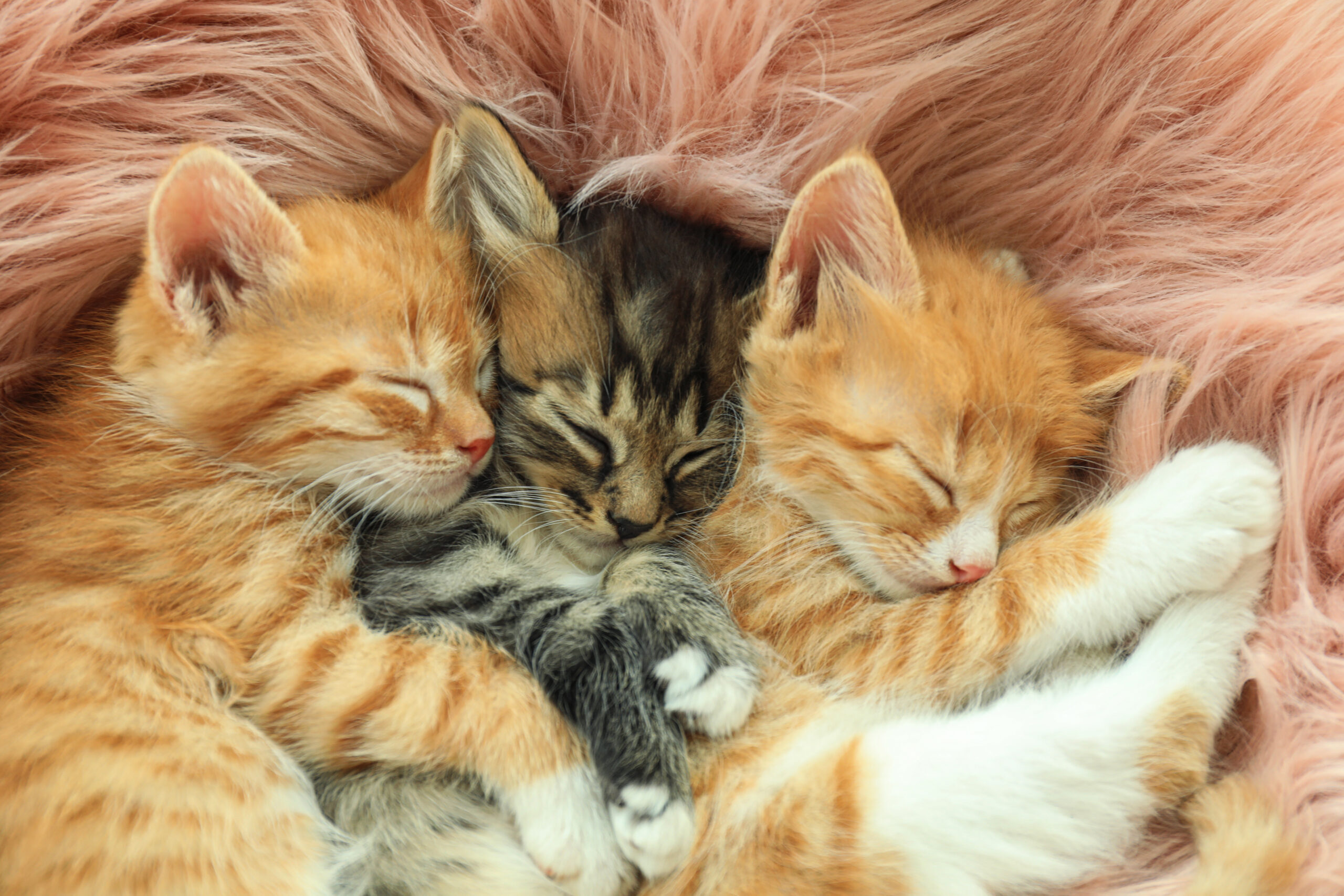
If you’ve been anywhere near a shelter’s social media lately, you’ve probably seen the term floating around, usually paired with thirty photos of tiny, wobbly kittens and a slightly frazzled caption. It sounds charming, and in some ways it is. But the cuteness hides just how much pressure this time of year puts on shelters like ours, since newborn kittens need round-the-clock bottle feeding and warmth that most shelter buildings, Good Mews included, simply aren’t staffed to provide. That’s exactly why foster homes carry so much of the weight during this stretch.
Here’s what’s actually going on, and what to do if you find a kitten yourself.
What’s Happening
Cats are seasonally polyestrous, meaning their fertility is tied to daylight. As days get longer, more cats go into heat, and an unspayed female can have multiple litters in one season. The result is a predictable wave that runs from early spring through late fall and peaks right about now, in late spring and early summer. Nationally, shelters take in an estimated 1.5 million kittens a year, most of them during this exact window, and Good Mews feels that wave too, from our placement waitlist to our foster program to our community cat emails. If you have outdoor cats who haven’t been spayed or neutered yet, this is the time of year you’ll start noticing it: rounder bellies now, kittens not long after.
If You Found a Kitten Outside
Your first instinct is probably to scoop the kitten up. Resist that, at least at first. The most common kitten-season mistake is assuming a kitten’s been abandoned when mom is simply out hunting or hiding nearby until you leave.
Look, don’t touch. Check whether mom is nearby, whether there are siblings you haven’t spotted yet, and whether the kittens look healthy. If mom isn’t immediately present, wait three to four hours before assuming she’s gone for good.
From there, the age of the kittens shapes what happens next:
Under two weeks old, kittens are fragile and completely reliant on mom. They can’t regulate their own body temperature yet.
Two to four weeks, their eyes are open and they’re starting to explore and socialize, but they’re still nursing.
Four to six weeks is a key social window, and kittens are starting on solid food.
Six to eight weeks, kittens are fully weaned, more independent, and old enough for spay or neuter surgery, though they also get harder to socialize the older they get.
At any of these stages, if mom is nearby, healthy, and the kittens are under two months old, the right move is to leave them be. Nursing gives kittens nutrients you can’t replicate, and it also lowers mom’s risk of a painful mammary infection. If mom hasn’t returned after three to four hours, or the kittens seem sick, that’s when it’s time to step in.
From there, make a plan before you act. If you’re going to need a trap, it’s because the kittens (and likely mom) will be spayed or neutered and returned to their outdoor territory. If they’re headed into an adopter’s home or a shelter instead, a carrier is usually all you need. Either way, don’t trap until you have a confirmed clinic or intake appointment lined up. Showing up with kittens and no plan just adds stress for everyone involved, including you.
Locally, you can reach our community cat program at ccp@goodmews.org with questions, our placement team at placement@goodmews.org to request placement, or spayneuter@goodmews.org to schedule a surgery appointment. Be prepared for the process to take some time. Local rescues and shelters get flooded with requests this time of year, so it’s worth assuming you may need to foster the kittens yourself in a safe indoor space for a while, even after you’ve reached out. Placement isn’t impossible, but during peak kitten season, it’s rarely fast.
How You Can Help
Foster. The single highest-impact thing most people can do; usually a matter of weeks, and a good program covers supplies and vet costs.
Adopt instead of buying. Every shelter kitten already arrives spayed or neutered and vaccinated, which means one less future litter.
Spay and neuter early. Kittens can be safely fixed as young as eight weeks and two pounds, well before the outdated six-month rule of thumb.
Support trap-neuter-return for community cat colonies near you.
Donate or volunteer. Kitten season runs on formula, heating pads, and laundry, and a shelter’s wishlist is its bottleneck just as much as space is.
Kitten season is tough, but not impossible to manage. It’s predictable, which means it’s something we can plan for every single year, together.
Sources
ASPCA. (n.d.). I Found Kittens Outside, What Do I Do?
https://www.aspca.org/helping-people-pets/i-found-kittens-what-do-i-do
Best Friends Animal Society. (2025). Found a Kitten? Wait Before You Act. https://bestfriends.org/kittens/found-kitten-what-to-do
Cat Adoption Team. (n.d.). What to Do When You Find a Kitten.
https://catadoptionteam.org/resources/what-to-do-when-you-find-a-kitten/
Shelter Animals Count. (2024). Managing Kitten Season: Supporting Overwhelmed Shelters and Rescues. https://www.shelteranimalscount.org/managing-kitten-season-support-overwhelmed-shelters-and-rescues/
Sen, M. (2025, June 6). Welcome to kitten season, when animal shelters need all the help they can get. NBC News / Associated Press. https://www.nbcnews.com/news/us-news/welcome-kitten-season-animal-shelters-need-help-can-get-rcna211383
Alley Cat Allies. (2015). What to Do if You Find Kittens Outdoors.
https://www.alleycat.org/community-cat-care/finding-kittens-outdoors/